

As a kingless, queenless, monarch-free nation, what do we decide to put in the space that best represents us to the world? Why is the Washington Monument a giant obelisk? And while we're at it, what's the deal with Donald Trump's proposed Triumphal Arch?
Today we are guided by an actual, real-life, architectural tour guide, Carolyn Muraskin of DC Design Tours. She walks us through the many ups and downs of DC's rich design history, along with the many controversies that surrounded what we put on the National Mall.
Transcript
Nick Capodice: Hannah, how old were you the first time you went to Washington, D.C.?
Hannah McCarthy: I know my parents took me when I was a baby, but the first time I really understood where I was and chose to go there was right after I graduated from grad school.
Nick Capodice: Do you remember how you felt the first time you saw the National Mall?
Hannah McCarthy: Yeah, I was in awe, honestly.
Nick Capodice: So my dad had driven my sister and I there when I was eight years old, and we went because he wanted to visit [00:00:30] when the cherry blossoms were in bloom. And I don't even know what that meant. But listen, I had already become a sarcastic, coffee drinking skeptic of the world at that point. But the first time I saw the National Mall, I was struck full of emotion and reverence. I could not believe I was actually there.
Hannah McCarthy: Do you think when you were eight, you had a sense that that whole space was very purposefully designed to evoke that emotion and reverence? Or were you just like, [00:01:00] wow.
Nick Capodice: Well, it did feel unlike anywhere I'd ever been in my life. Like like it was another planet, like ancient Greece or Egypt. But in the future, you know what I mean? You know what I mean when I say that?
Hannah McCarthy: Yeah, I know what you mean.
Nick Capodice: And yeah, I knew the National Mall is this curated thumbing our nose at the monarchy thing. But how do you do that, exactly? When you're a nation that doesn't have kings or emperors when you're a new nation? What symbols, what statues or [00:01:30] monuments represent you to yourself and to the rest of the world?
Carolyn Muraskin: So much of our downtown architecture is classically inspired, right? Greek. Roman. As if we as a new America are the next manifestation of Roman, of the Roman republic of Roman democracy.
Archival: Facing a wide lagoon stands the classical white marble Lincoln Memorial. Its 36 Doric columns represent the states of the Union. At the time that Lincoln was president.
Nick Capodice: You're [00:02:00] listening to Civics 101. I'm Nick Capodice.
Hannah McCarthy: I'm Hannah McCarthy.
Nick Capodice: And today we are talking about the history, design and intention behind the carefully crafted project that was and is our National Mall in Washington, DC.
Archival: It was a very emotional scene here this weekend, as veterans shed tears as they looked at the various aspects of the monument, or their faces filled with joy as children asked for their autograph or looked them in the eye and said, thank you.
Nick Capodice: It's a history that I hope will help us [00:02:30] understand the controversy around some of the recently proposed changes and additions, namely Donald Trump's triumphal arch.
Archival: You just heard from one of those veterans there. It's the the wrong monument, the wrong place, and honoring the wrong man.
Nick Capodice: We are going to get into everything National Mall related. Stick around.
Hannah McCarthy: Hang on. You were drinking coffee at eight. I was. Oh, boy. Nick.
Hannah McCarthy: Nick.
Nick Capodice: Yes, Hannah.
Hannah McCarthy: Why is it called a mall? [00:03:00]
Nick Capodice: Is that really where you want to begin?
Hannah McCarthy: I have to begin there. We have to get it out of the way.
Carolyn Muraskin: The word mall comes from a game called Pall Mall, which is sort of like the predecessor to croquet. You know, like like bougie game.
Nick Capodice: This is Carolyn Muraskin. She is going to be our tour guide throughout this episode, which is appropriate because she is the founder of D.C. Design Tours in Washington, D.C..
Carolyn Muraskin: I'm an architect by training, so I studied architecture. I worked as an architect for five years. And then I say this on all my tours. [00:03:30] I decided I like to talk about buildings a lot more than I like to draw them.
Nick Capodice: But yeah, Hannah, a game, a game called Pall Mall.
Hannah McCarthy: A game like croquet.
Nick Capodice: Palomagglio is the original Italian name, and it literally translates into ball mallet.
Carolyn Muraskin: So to play Pall Mall, you need a big lawn. Sometimes it was grass, sometimes it was clay. But because it was a game of the aristocracy, it was like a place to see and be seen. So to, you know, show off what you're wearing, who you're courting. And you would promenade on the mall of the Pall Mall. And in British cities, [00:04:00] the main streets are often called Pall Malls. So that's that's where the term comes from. The game Pall Mall. So from that gathering space we get shopping mall. It's a gathering space for shopping. We get National Mall. It's a gathering place for the nation.
Nick Capodice: Did you have a mall you went to when you were a kid?
Hannah McCarthy: South Shore Plaza, I had the mall everyone went to when I was a kid.
Nick Capodice: Mine was the Steeplegate Mall in Concord, New Hampshire, and it was indeed a place to see and be seen. Shout out to the long dead Aladdin's Castle video game [00:04:30] arcade and their Jurassic Park pinball machine.
Archival: Welcome. To Jurassic Park.
Nick Capodice: But we are not here to talk about those kinds of malls. We are talking emotion and reverence. And to talk about the story of the National Mall. We have to start with Washington, D.C., right? That this place became our nation's capital.
Hannah McCarthy: Agreed.
Carolyn Muraskin: Can I give you a timeline to start? And then we can build off of that. Okay, So DC was not the first capital. It depends when you start [00:05:00] measuring, but first let's say New York, then Philadelphia, then Washington DC. So DC becomes the capital in 1791 with the passage of something called the Residence Act.
Hannah McCarthy: Can we address the swamp question? People say it was a swamp.
Nick Capodice: People say so many things, Hannah.
Carolyn Muraskin: It was not a swamp. I'm always trying to dispel the myth that DC was built on a swamp, but it was very rural. It was 19 original landowners. And I often make my tour guests repeat after me. It was firm, dry riverbank and I make them say firm, dry riverbank. [00:05:30] I won't make you do that.
Nick Capodice: It was firm, dry riverbank. I'm sure Carolyn appreciates that.
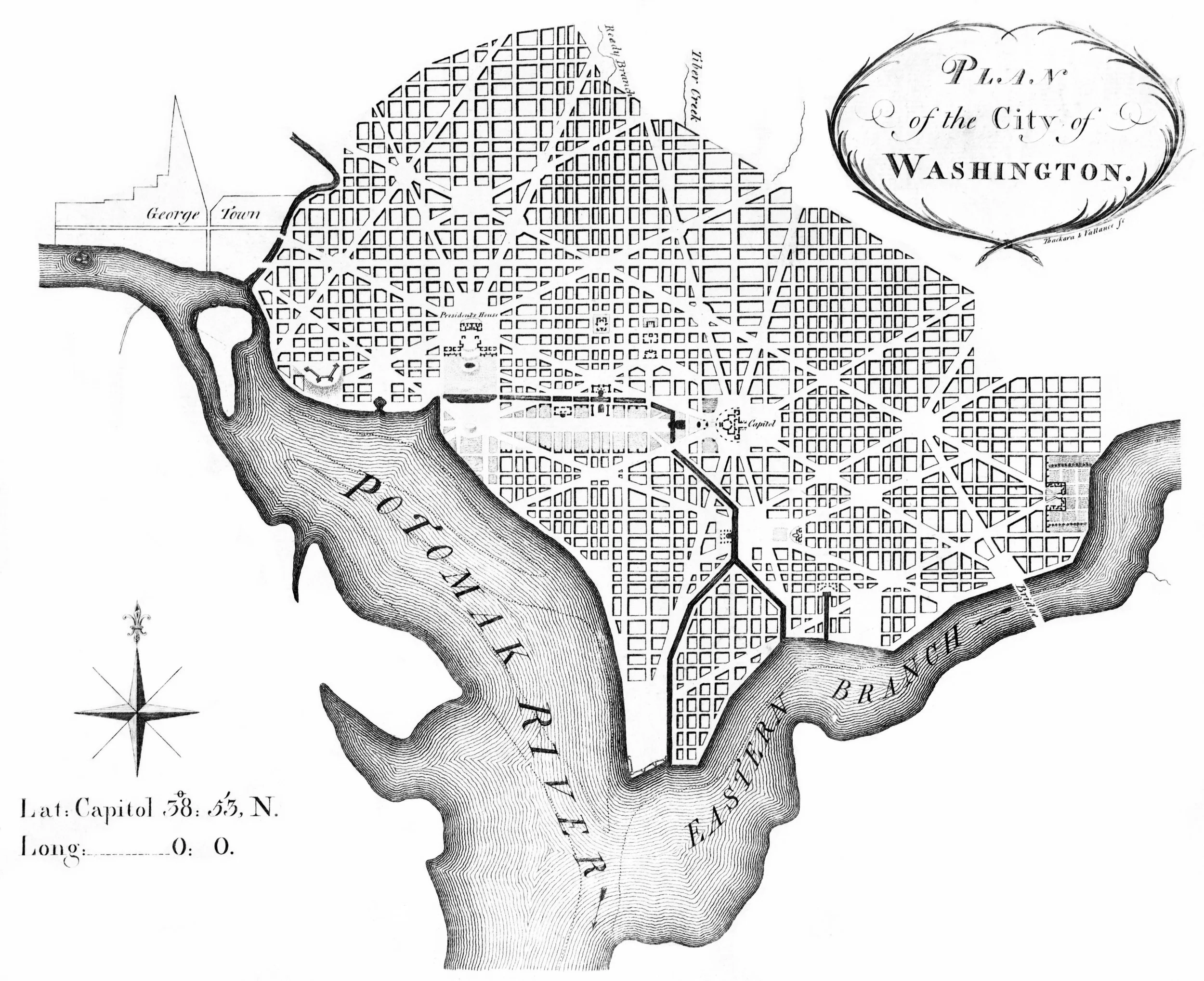
Carolyn Muraskin: Yes. Thank you. So not a swamp. Now to plan our new federal city. Because DC is unique in that it is fully planned out. Unlike, say, like Boston or Philly or New York. George Washington hires. And we're about to get to the National Mall, this Frenchman named Pierre L'Enfant or Peter L'Enfant.
Nick Capodice: So Pierre L'Enfant is one of these really important visionaries. And the L'Enfant plan, as people call it, is still something you [00:06:00] can see in the design of D.C. and the National Mall.
Carolyn Muraskin: Now, L'Enfant had fought in the American Revolution, but by training, he was an artist and a city planner. He's from Paris, and so he is the one who lays out the plans.
Nick Capodice: A lot of what we're talking about in today's episode is visual in nature. You know, we're talking about design. So I'm going to put a bunch of photos on the web page for this episode. I've got a link down there in the show notes if you want to see it yourself. So the first image is L'Enfant plan. It is a black and white map of his grid. Now remember, [00:06:30] none of these streets were there yet. It was farms and businesses and homes. So this plan is a proposed network of numbered streets going north and south, lettered streets going east and west, and big long diagonal avenues, which are named after states.
Hannah McCarthy: At this point in D.C.. Do we have all 50 of them, or are there 50 avenues, each named after a state?
Nick Capodice: There are indeed, there are 51 actually named after the 50 states and Puerto Rico. The most prominent being Pennsylvania Ave.
Carolyn Muraskin: Pennsylvania [00:07:00] being the most powerful state. Right. They got the main drag. And then he picks a spot for the white House just to the north of what was then called the public grounds, and then the capital at the end of the what was the national becomes the National Mall. Now L'Enfant actually gets fired. So he never has a chance to see see his city to fruition because even though he had this grand master vision, he had no patience to wait for the red tape of government to churn. And he just started bulldozing. Like before they bought the farmland. He was knocking down people's houses and he was cutting down their crops, and he was [00:07:30] shooting their cattle. And so he gets fired.
Hannah McCarthy: He was shooting cattle.
Nick Capodice: Yeah. You don't have to be on a PIP to get fired for that. So L'Enfant is out and two other guys step in named Andrew Ellicott, who had, interestingly enough, previously surveyed Niagara Falls and Benjamin Banneker.
Carolyn Muraskin: Benjamin Banneker was actually free African American man who had worked as a surveyor. He also corresponded with Thomas Jefferson arguing about, you know, the concept of all men are created equal with the institution of slavery still [00:08:00] in full steam. So these two men, Ellicott and Banneker, really executed L'enfant's plan. That's where the origin of the National Mall comes from, an idea of a public gathering space.
Nick Capodice: By the way, the original mall was only half the length it is now. It went from the Capitol building to the Washington Monument. And that monument, by the way, started to get built in 1848, and it wasn't finished until much, much later.
Carolyn Muraskin: So the Civil War is is the biggest turning point for Washington. This is what historians [00:08:30] say converted Washington from a town to a city. So before the war, there's about 75,000 people. During the war, we get a huge influx, thousands upon thousands of first of all, Union troops, right? Federal troops are pouring into the capital to protect us. D.c. becomes the most fortified city in the world by the middle of the Civil War, because we're surrounded on all sides by enemies, right? Virginia to one side, Maryland to the other, which technically was part of the North, but Maryland was very much Confederate leaning. And then beyond that, we get refugees, right? [00:09:00] People in formerly enslaved people fleeing their enslavers, moving north to build a life for themselves. D.c. is the furthest south of the northern city. So this is where people were aiming to go. And then other folks either fleeing or coming to profit from the war. So the population of Washington just explodes. We go from 75,000 to 120 5000 in 4 years.
Nick Capodice: But, Hanna, we did not have the infrastructure to support this population explosion. And D.C. started to hit some pretty hard times. And so even as [00:09:30] the Washington Monument is being constructed very slowly, things were not going well.
Carolyn Muraskin: Post-civil war D.C. is in a really rough state. Just as an example, the area just off the mall that Pennsylvania Avenue runs along. So there's a triangle, right? The mall. I know no one can see the shape that I'm making. That was known as murder Bay, right on Pennsylvania Avenue, right on the mall. So that's where all the brothels and the saloons and the gambling halls were. That's where in formerly enslaved people who had no resources had to go to settle. There was a disgusting [00:10:00] canal that ran along it that became basically an open sewer. And so GC is in really rough shape, and it gets so bad that around the turn of the century, really in the 1880s, Congress actually entertains the idea of abandoning the federal capital altogether.
Hannah McCarthy: Just give up on the whole thing.
Nick Capodice: Just throw it out and start over somewhere else. Do you want to guess the main contender for the new nation's capital?
Hannah McCarthy: It wasn't one that we'd already tried, right?
Nick Capodice: No, it actually was the gateway to the West [00:10:30] Mound City, the Lu.
Hannah McCarthy: Saint Louis.
Nick Capodice: Saint Louis. My Midwestern heart swells with pride, but as we all know, DC stayed where it was and they decided to get cracking.
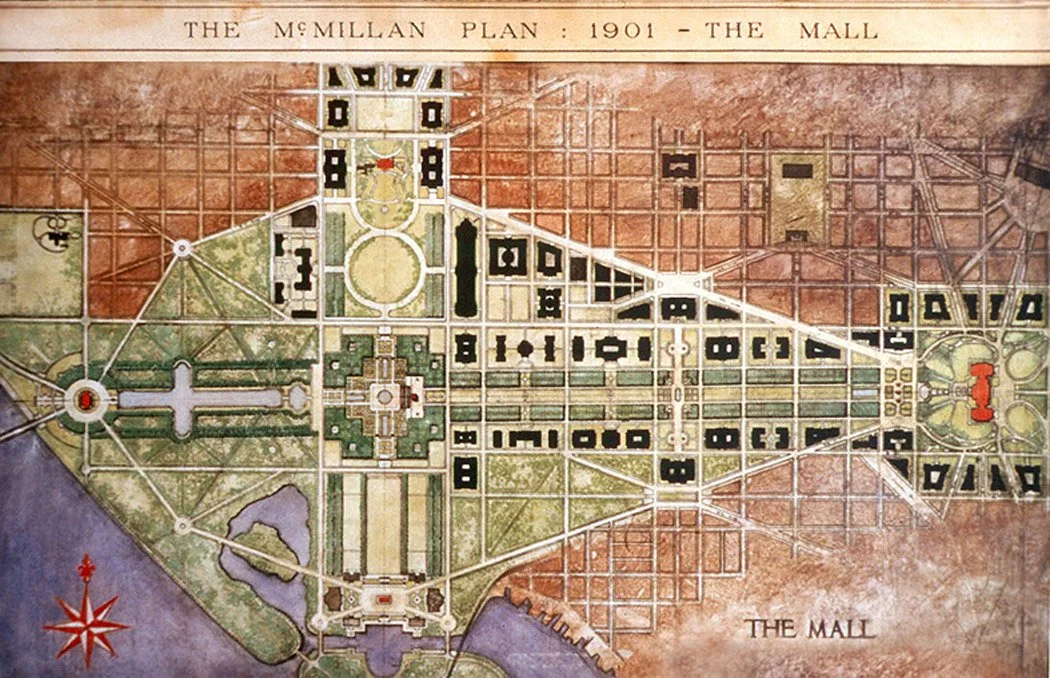
Carolyn Muraskin: This notion serves as kind of a kick in the pants to get Congress to really invest in Washington and make it worthy of the nation. There's a great book about this called worthy of the nation. So that is when all of these huge infrastructure expansion urban planning [00:11:00] projects come together, which is codified within the McMillan plan, which comes out in 1901.
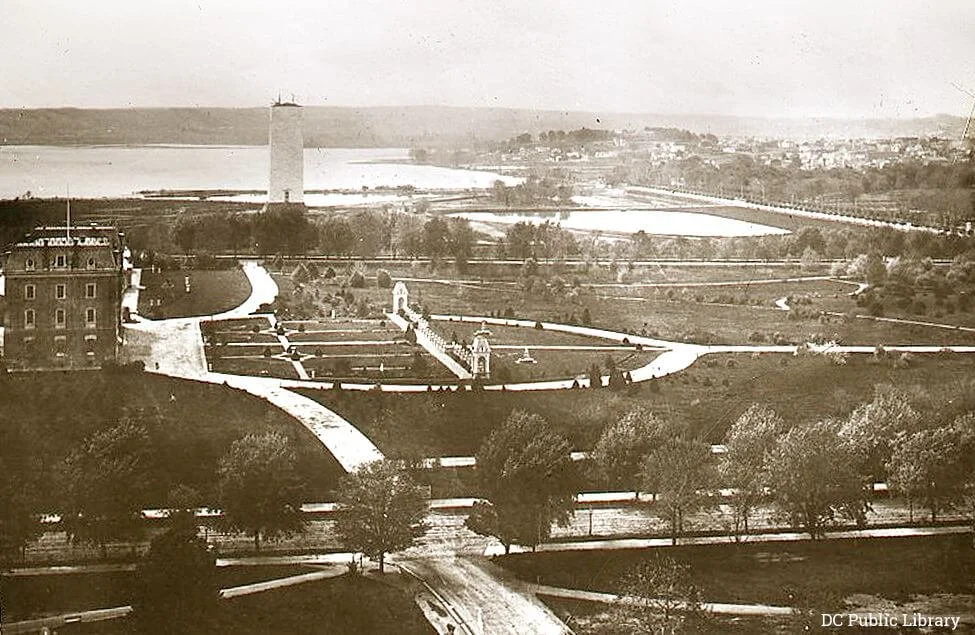
Nick Capodice: So the McMillan plan and my goodness, there were a lot of plans that was actually put together by a whole bunch of people. And Michigan Senator James McMillan was the one who sponsored the legislation and got everybody together. Now, by this point, the Washington Monument was finished, including its pointy little top made of aluminum, which was very fancy at the time. But the McMillan plan planners had some other [00:11:30] big plans in store, and that meant they needed to expand the National Mall into new areas.
Carolyn Muraskin: So one of the big ones was that in between what we now think of as the Lincoln Memorial and the Washington Monument that was at this point marshy, it was called the Potomac Flats.
Hannah McCarthy: Marshy?
Nick Capodice: Yes.
Hannah McCarthy: I thought it was together now. Firm, dry riverbank.
Nick Capodice: Good catch. Hannah.
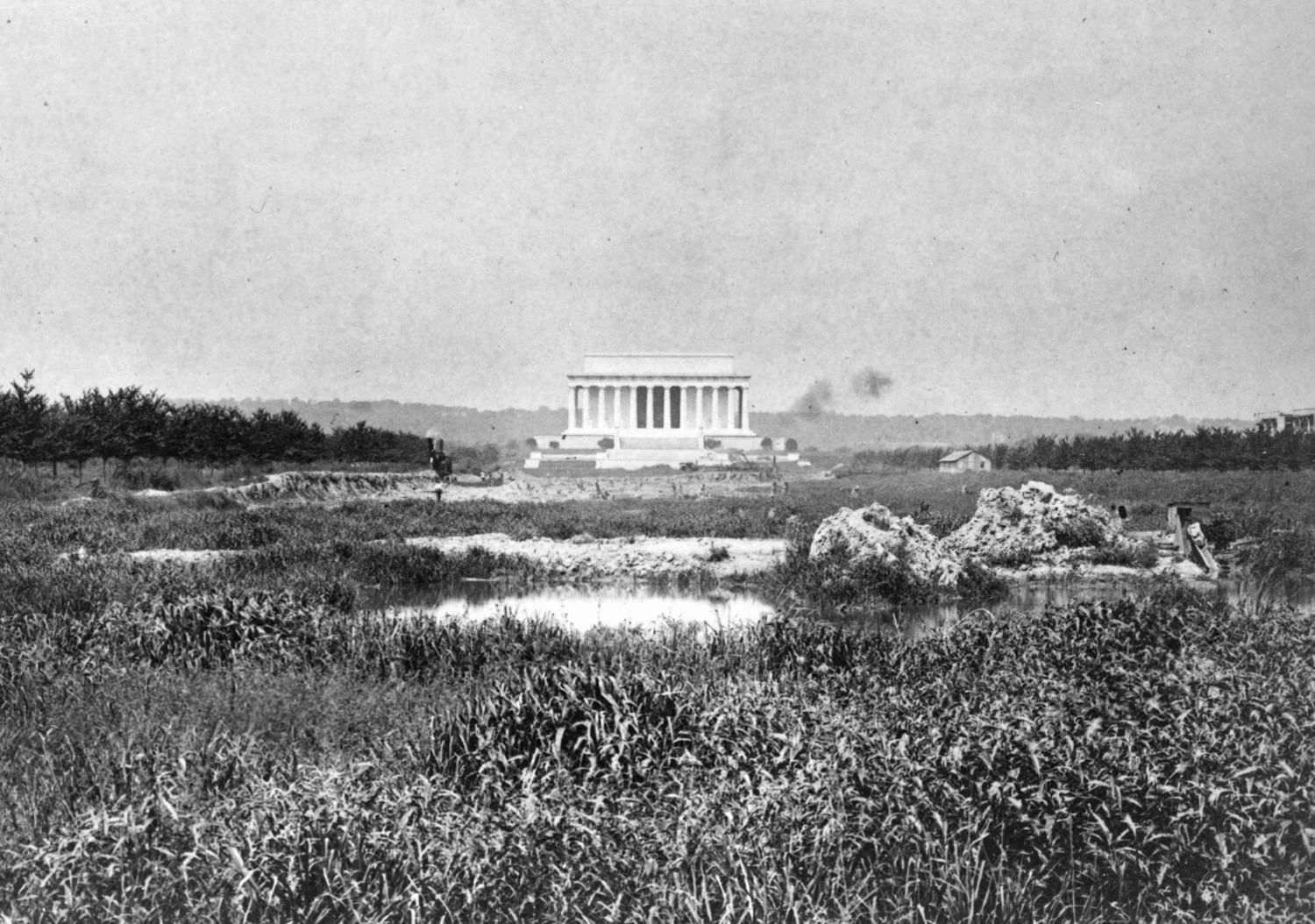
Carolyn Muraskin: Now, to clarify, it was not a swamp when DC was established, but it becomes swampy later [00:12:00] because of our own activity. Agriculture upriver, the silt and the sediment is coming down and building up these mudflats. So during the McMillan plan and the build up to the McMillan plan, the Army Corps of Engineers extends the mall out to fill in the Potomac Flats. And that's how we get all the way to the Lincoln Memorial.
Nick Capodice: I am putting a photo on the website of the Lincoln Memorial in 1917. It looks horrible. It's just Lincoln sitting out there in a bunch of mudflats surrounded by scrub and brush. [00:12:30] In fact, speaker of the House Joe Cannon once said, quote, so long as I live, I'll never let a memorial to Abraham Lincoln be erected in that g d swamp.
Carolyn Muraskin: But one of the reasons they put Lincoln out there was to motivate, to fill in the gap in between with the Reflecting pool and eventually the World War Two memorial. So that's how the full breadth of the National Mall comes to fruition.
Nick Capodice: All right. So we've laid out the history of D.C. and the mall. But now I want to focus on what is in it. We're going to talk about some of the monuments, as [00:13:00] well as a proposed monument right after a quick break.
Hannah McCarthy: We're back. You're listening to civics 101, and we are talking about the design of the National Mall. And Nick, you promised me monuments, specifically the tallest spikiest one in the city. The one I once referred to as that big old stick. What's the story of the Washington Monument?
Nick Capodice: Here again is D.C. [00:13:30] architectural tour guide Carolyn Muraskin.
Carolyn Muraskin: Washington monument. That's the first monument memorial on the mall. It was finished in 1884, open to the public in 1888. It was not what was originally envisioned because Pierre L'Enfant had a vision. He was very dedicated to George Washington. He was aide de camp to Washington. Washington was almost like a father figure to him. So what? What? Pierre L'Enfant wanted to build was a 350 foot tall gold equestrian statue of George Washington. So, like Statue of Liberty gold. [00:14:00] Washington would have hated it. So it never got built. L'enfant, of course, got fired. And so the project actually languished for a long time. It wasn't until the 1840s it was picked back up again. They're, you know, trying to make the mall more viable. So there was a commission form. They held a design contest. The winner was this guy, Robert Mills. He designs this giant Egyptian obelisk originally had a ring of columns around it with an equestrian statue of George Washington that was pared down due to budget cuts. Classic DC line. Um, the reason [00:14:30] they chose the obelisk is because of the Freemasons, right? You know, the symbolism surrounding the Freemasons, all are taken from ancient Egyptian tradition. So that's also why you have the pyramid and the all seeing eye in the back of the dollar bill. So a huge obelisk makes perfect sense. Again, George Washington would have hated it because he was always very, um, nervous about being deified or like made into a king or a god. And this is like. Literally a symbol of the pharaohs. But hey, he was long dead, so whatever.
Nick Capodice: I want to [00:15:00] hop in here, Hannah, and reiterate something we said at the very top, which is, yes, you got statues of Lincoln and Jefferson, but we are a new nation built on some very old and some very new ideas. America is not an Athenian democracy, but we are a democracy. We're not the Roman Republic, but we are a republic. So this is why the National Mall feels very Greek and Roman columns, [00:15:30] white marble, a classical esthetic.
Carolyn Muraskin: And that esthetic, it it comes in waves. So the capital in the white House, right when they were designed. We're talking early 1800s. So of course, there's been lots of expansions. They were designed in that classical esthetic. Then it kind of falls out of fashion. And it comes back in the 1920s and 30s during a time of great instability with the Great Depression and World War Two. And that's when a lot of what we call federal triangle is built up. A lot of those big, imposing federal office buildings to communicate a [00:16:00] strength and stability of government, its architecture as propaganda.
Nick Capodice: It is as if they wanted these federal buildings to feel ancient, eternal, unbreakable. And you know what? They succeeded. Like my brain knows, some of these buildings are less than a hundred years old, but I feel like they are ancient.
Hannah McCarthy: Yeah, I agree with you. It's a pretty good trick. And hang on. Did Carolyn say that the designer of the Washington Monument won a contest? [00:16:30]
Nick Capodice: Yeah, and that is maybe my favorite thing I learned making this episode. Just about everything on the mall is designed the way it is because somebody won a contest, which seems appropriate, right? If the mall is here to represent the ideals and icons of democracy, Why not let the people design its most important features.
Carolyn Muraskin: To this day? Most of our famous monuments memorials, museums are designed by independent, anonymous contests. So that means, like any of [00:17:00] us could design something as famous as, say, the Vietnam War. That's a very famous example. That's Maya Lin. She was a 21, I think she was 19 when she did the design. She was a landscape architecture student from Yale. And she did this design for as a project class project. And she submitted it to the contest on a whim. And she won out of, I think, over 1400 submissions. The white House has one by this man named James Hoban, who was an Irish architect. The Capitol was designed by a guy named William Thornton, who was actually [00:17:30] not an architect at all. He was a doctor from the West Indies. Lincoln also contests, that is, um, Henry Bacon as the architect. And Daniel Chester French is the sculptor.
Hannah McCarthy: You know how I feel about the Lincoln Memorial.
Nick Capodice: Yeah. I'm going to put a link in the show notes also to one of my favorite episodes we ever did at Civics 101, where we walked around the Lincoln Memorial with a microphone out and Hannah just spoke her heart. But let's talk real quickly about its architecture.
Carolyn Muraskin: So the Lincoln Memorial is built as a literal temple, like the Parthenon modeled after the Parthenon. Same columns [00:18:00] around the edge. There's 36 columns around the outside, representing the 36 states that were part of the United States when Abraham Lincoln was assassinated. The list of the rest of the states are above that, except for Alaska and Hawaii. They're always getting left out of stuff. They weren't states, you know, in 1922. Then we've got, of course, the statue of the god inside, like you can imagine a statue of seated Zeus. He's in the same position, in fact. So when you look at a lot of classical sculptures of Greek gods, especially Zeus, they have one foot forward. So this is meant to represent that Lincoln [00:18:30] was a contemplative person, but he could rise up at any moment.
Speaker 8: Yeah. I feel from everything that I have read about and from Lincoln, he represents in certain ways the philosopher king, right? The one who thinks and waits and at the same time. Indeed, rises up when the occasion calls for it, for example, in preserving the Union. Yeah.
Carolyn Muraskin: Drake behind him in his big chair is the American flag. So he's sitting there protecting the country, protecting the flag. One hand is [00:19:00] clenched to his strength and war. The other is kind of loose to show his strength and diplomacy. So you can see they're pulling in all of these sort of national ideologies and philosophies that, you know, we're envisioning Lincoln had. And then on the inside, there's his two famous speeches. There's the Gettysburg Address and the second inaugural address. And those, of course, very intentionally selected. The second inaugural address is quite kind of like fire and brimstone, talking about how our country is awash in blood as God's punishment for the sins of slavery. But it [00:19:30] also has that line with malice toward none, with charity for all. All of this is trying to sort of embody these high minded ideals that Abraham Lincoln himself embodied, at least in the American imagination.
Nick Capodice: And one of those ideals, to me at least, is not American exceptionalism. It is America's place in the larger picture. The last line of that second inaugural is quote to do all which may achieve and cherish a just and lasting peace among ourselves [00:20:00] and with all nations.
Carolyn Muraskin: Similarly to how George Washington would have hated his monument. It's not really about the person, it's about what they symbolize for the nation.
Nick Capodice: You've seen the World War Two Memorial, right?
Hannah McCarthy: Yeah.
Nick Capodice: Yeah, it actually is.
Hannah McCarthy: I think it really well communicates the unbelievable scope and scale of World War Two, the way it communicates the various theaters of war.
Nick Capodice: Yeah. [00:20:30] I was struck by the sound, like the rushing of water. Like like a drumbeat.
Hannah McCarthy: Oh, the rushing of water is just. Yeah.
Archival: Here for the dedication of their World War Two memorial, a day to honor not just those who served in uniform, but an entire generation of Americans who accomplished nothing short of a miracle.
Archival: They gave the best years of their lives to the greatest mission their country ever accepted.
Archival: I was in the United States Army Air Corps, and [00:21:00] this has been a heck of a day today.
Nick Capodice: So that memorial opened in 2004. It recognizes those who served and those who died in World War two. Also, it recognizes our union. It's got 56 pillars representing the US states and territories. And I want to point out the commission to create it was signed into law by president Bill Clinton, and it was dedicated on opening day by President George W [00:21:30] Bush. And this memorial was the result of many hands. It was developed by the United States Commission of Fine Arts, the US Army Corps of Engineers, the National Capital Memorial Commission, the National Capital Planning Commission, the National Park Service, all advising the American Battle Monuments Commission. It was the result of a ton of people's work.
Hannah McCarthy: Which is appropriate because to me, that memorial really communicates something that's so much bigger than any one individual or any one [00:22:00] choice.
Nick Capodice: Yeah. And here's another thing about that memorial. It is between the Washington Monument and the Lincoln Memorial, and it is sunk down into the ground. And the reason for that is because the various designers of the National Mall have put a lot of thought into how these different buildings across the mall connect visually and symbolically.
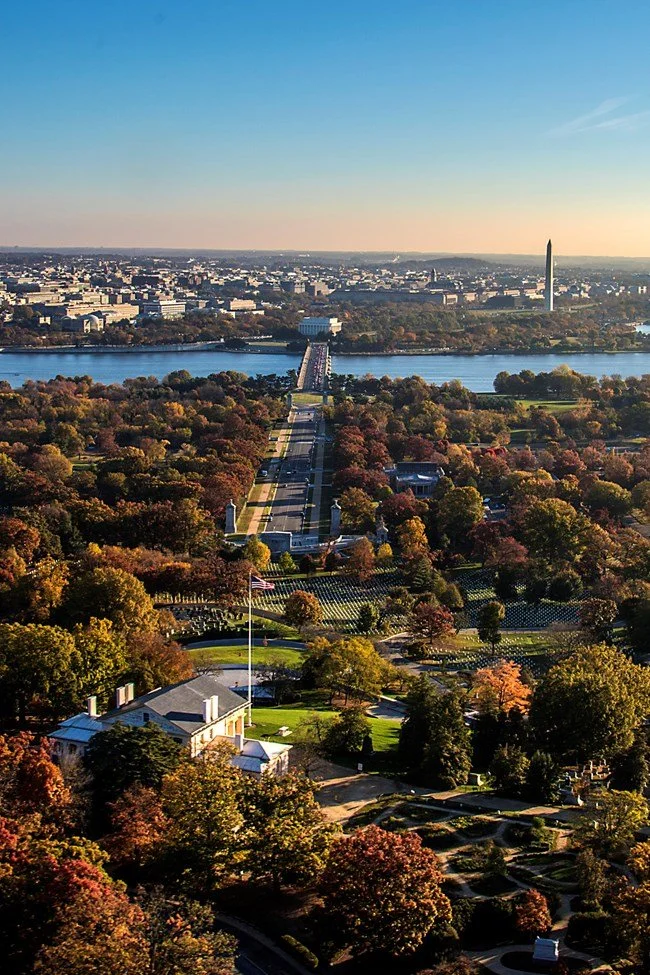
Carolyn Muraskin: The reason the World War Two Memorial is built where it is, was to connect Washington to Lincoln, but to preserve the view, to preserve the view between the man who created [00:22:30] the country in quotes and the man who preserved the country. So that's why the World War Two memorial is sunk down and the tall elements are pushed to the side because they didn't want to disrupt that axis. And that axis continues across the Memorial Bridge behind the Lincoln Memorial to Arlington Cemetery, which. If you know the history of Arlington, the house, the yellow house at the top of the hill that was Robert E Lee's house. So the leader of the Confederate Army was living across the river when the Civil War broke out. He left, his land was seized, and they basically buried so many Union troops in [00:23:00] the ground that the Lee family could never come back. As punishment for their involvement in the Civil War. So the origin story of Arlington Cemetery is really a revenge story. But when they built the Memorial Bridge to connect Arlington Cemetery to the Lincoln Memorial, this was meant to be a symbol of reunification, literally bringing north and South together.
Nick Capodice: And here is where I'm going to pivot to a proposed monument. It's not yet built. It is the subject of much controversy. The United [00:23:30] States triumphal arch.
Archival: The Trump administration says the president's 250 foot triumphal arch will break ground in the next two weeks, but the project has yet to even get final approval. Interior Secretary Doug Burgum announcing the news online, promising the arch will be one of the great pieces of American architecture.
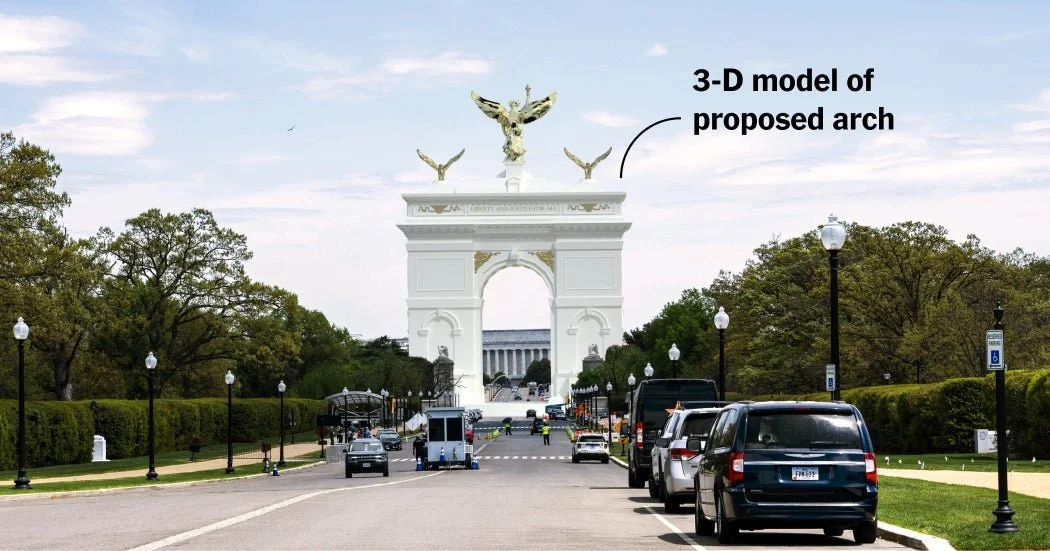
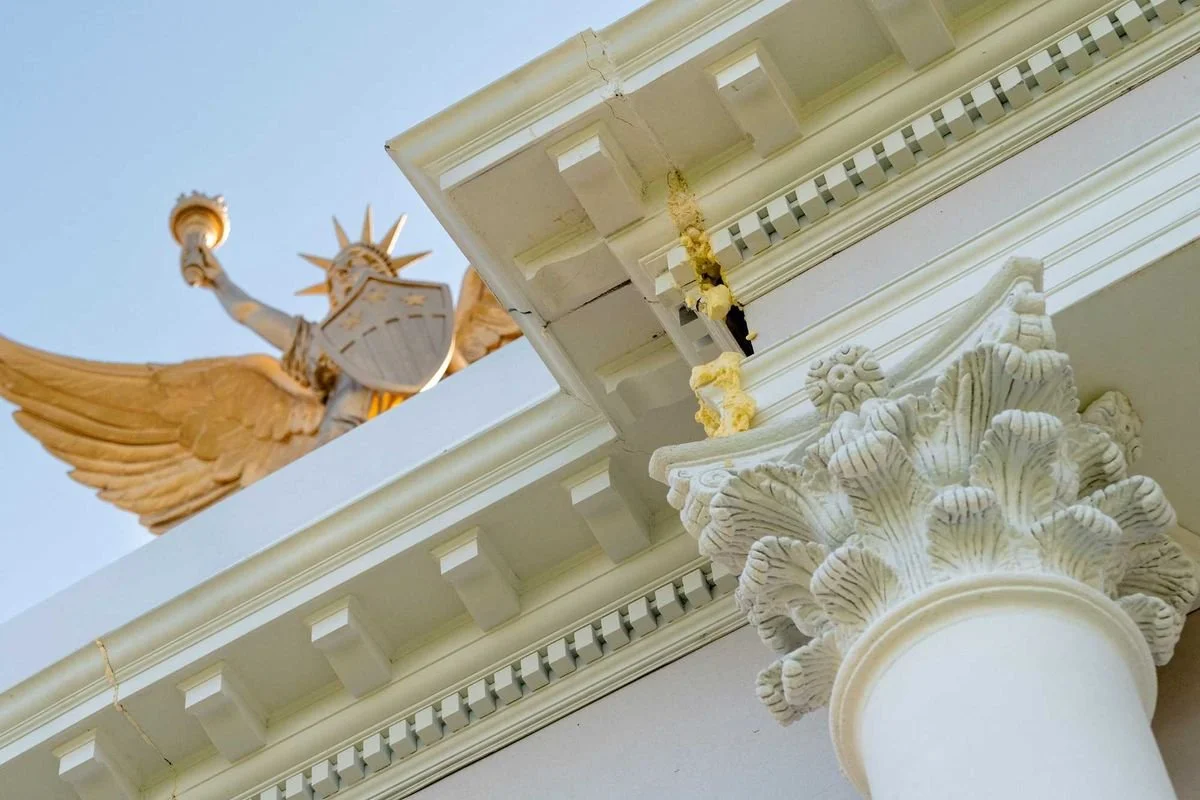
Nick Capodice: There have been several releases from the white House on what the proposed arch could look like. I'm going to put a few of those images on the web page for this episode. It is an arch that looks [00:24:00] a lot like l'Arc de Triomphe in Paris. It's got a gold statue on the top, columns on the side. You just got to see it.
Archival: The structure itself would clock in at 166ft tall, with the added statue on top, bringing it to 250ft.
Nick Capodice: So if people out there are wondering why this has been so controversial in a place that is all about big grand memorials and monuments, part of it is about sight lines. So if you stand at the back of the Lincoln Memorial, you can see all the [00:24:30] way to Arlington Cemetery and the Arlington House, and the front of which is the grave of John F Kennedy and the Eternal Flame. Kennedy visited Arlington Cemetery just days before he was assassinated.
Archival: Ladies and gentlemen, your attention please. The president has entered the cemetery and is receiving a 21 gun salute at the present time. He will arrive at the north. Walk to the amphitheater in approximately two minutes, and proceed to the plaza to place the presidential wreath at the tomb of the unknowns.
Carolyn Muraskin: And [00:25:00] he had gone and laid a wreath at the tomb of the Unknown Soldier. He had watched changing of the guard, and had gone up to Arlington Mansion and looked out the other way, right across this amazing view, all the way across Lincoln Memorial, the Washington Monument, the Capitol in the distance. And he supposedly quietly said something like, wow, I could stay here forever. So Jackie, she remembers this, and she wants to bury him as close to that spot as she can. So he is also buried on axis with the Lincoln Memorial, the bridge, the house.
Hannah McCarthy: And where is Donald Trump's [00:25:30] proposed location for the proposed triumphal arch?
Nick Capodice: It is planned to be on a place called Columbia Island, which is directly between the Lincoln Memorial and Arlington. It's planned to be 250ft high, and if built, it will block the view of the Arlington House.
Hannah McCarthy: Every monument that we've talked about so far was the result of decades of deliberation planning among many people, right? We operate under a system of checks and balances. The [00:26:00] National Mall seems to be involved in that same system like everything else is supposed to be. What is the formal process to add something to the mall?
Nick Capodice: There's a lot.
Carolyn Muraskin: It's a long list. So there are six different organizations that are involved in this. There's the what they now call the National Capital Memorial Advisory Commission. Congress sort of. Then there's the U.S. Commission of Fine Arts, which is the oldest one. That's the one that was first established in the early 1900s. There's the Capital Planning [00:26:30] Commission, Ncpc. There's the General Services Administration, there's the National Park Service, and there's the State Historic Preservation Office. If it impacts something that's already there.
Hannah McCarthy: That is a lot of commissions.
Nick Capodice: Yes it is.
Carolyn Muraskin: So all of those organizations have a say in something built on the mall. Now there's a technicality because it's not being built on the mall, the arch. It's across the river on Columbia Island. So when that Commemorative works act was passed in 86, they established something called the [00:27:00] reserve, which basically said, we can't build any memorials in this spot or it makes it harder to build. And that's been adapted. I think the last change was in 2003. So basically the mall is closed for future memorials, at least as far as this. This congressionally approved document is concerned. So that's the reserve. And then there's sort of area one and area two. Area one is where the arch is slated for. And that is limited memorials. So it's not technically even though it's on the axis of the bridge. It's behind [00:27:30] the Lincoln Memorial. It's not on the technical boundaries of the mall.
Nick Capodice: And the final point of controversy is the symbolism of the arch. There have been plenty of disagreements and different ideas about the various elements of the National Mall throughout history, but you can safely say that all of them are deeply imbued with symbolic meaning.
Hannah McCarthy: What event or person does this triumphal arch purport to celebrate or memorialize?
Nick Capodice: Well, it depends on who and when you ask. [00:28:00] Most recently, in September of 2026, President Trump said it would double as a, quote, military complex with an ammunition storage, snipers and drones. And back in October of 2025, a reporter asked the president who the arch was for and Trump's reply was, quote me. So I asked Carolyn to tell me not what she thought of the proposed arch, but what visitors on her tours say.
Carolyn Muraskin: Most of the folks I've talked to consider it an abomination, [00:28:30] and showing a complete disregard and disrespect for the planning of the city, for the vision, both in the early phases with Pierre L'Enfant and the McMillan plan and now, um. And there's also a whole, you know, list of approvals that need to be gone through with the Commemorative Works Act of 1986 that are also just being completely disregarded. I think people see it as a monument to the president, uh, a living president, as a monument to ego and not as a real connection to the [00:29:00] nation. I mean, the time at which the Roman Empire, which is where triumphal arches come from, they were conquering, you know, they were an empire. They were not a democratic republic. So that symbolism feels kind of incongruous, especially with the United States today. There's also, of course, a financial component. Of course, people are like, why are we going to spend taxpayer dollars in the same way as the the demolition of the East Wing and the ballroom was supposed to be privately funded and it's not. Um, why are we spending money on this arch? Just the whole the symbolism of the arch itself [00:29:30] feels so incongruous to the state of the country now. And so I think a lot of people see it as just a monument to the president and his ego and his desire to leave a nationally visible footprint, as opposed to being motivated by something larger than himself. Right. By communicating the ideals of Abraham Lincoln or George Washington.
Nick Capodice: But there may be some listeners out there who remember another controversial [00:30:00] monument. It's one that I visited when I was a kid, my first time in D.C. the Vietnam Memorial, a controversial structure, a controversial war. It was not like when the World War Two memorial was announced. This one was debated.
Carolyn Muraskin: I mean, the Vietnam War. That is a great example of a very tumultuous time in American history. Right? Post-vietnam Vietnam veterans were treated horribly. The whole concept of a memorial to them would have been really unheard of in 1975. But over [00:30:30] time, our understanding of how poorly these veterans had been treated neglected. You know, the rise of PTSD and the explosion of the homeless population post-Vietnam. These were motivators behind building a memorial to them, almost as an apology. It's like it is a bit of an apology. The Vietnam War, um, showing reverence to the sacrifice of these men and women who, when they made that sacrifice, you know, the country was not necessarily supportive of them. And it's also evolved over time. When the wall was unveiled in 1982, a lot of people hated it. A lot of vets took [00:31:00] it as just another insult. They called it the black gash of shame or a scar on the land. And then, unfortunately, myelin caught a lot of flack herself for being a young Asian American woman.
Archival: I don't care about artistic perceptions. I don't care about the rationalizations that abound. One needs no artistic education to see this memorial design for what it is a black scar.
Carolyn Muraskin: It's completely evolved. The Vietnam War. Now it's a place of reverence and respect. And, you know, you come Memorial Day, Veterans Day, there's thousands of people there.
Nick Capodice: I am not going to put words in [00:31:30] Carolyn's mouth here, so I'm going to say it myself. To me, it feels that the difference between the proposed triumphal arch, which the president has said is meant to celebrate himself and the Vietnam Memorial, is that the former is not tied to a specific sacrifice or war. Controversial or not. And therefore I do not see how it could become what the Vietnam Memorial became something truly [00:32:00] meaningful to a great many Americans.
Archival: All these people in these walls, my friend, as far as I'm concerned, I wish they could have did something a long time ago. We didn't need no parades or that all we needed was a little bit of respect.
Hannah McCarthy: Washington, D.C. is its own city, and it is our city. It is the people's city. We the people, decide who gets to work there, or at least 537 [00:32:30] of the people who get to work there. If you want to include Congress, the president, and I guess the veep. There is a degree to which. Right. Dc is within our sphere of influence. And when it comes to what symbols represent us both, you know, to us and to the rest of the world. We have some influence on that, don't we?
Nick Capodice: We do. Like we say so often on the show, just throwing our hands up and saying, oh, we have no power. That only reinforces the idea [00:33:00] that we don't have any power. So I'm putting a link in the show notes from the National Trust for Historic Preservation. They have been working to save historic spaces for 75 years. On their website, they have a list of the many meetings, public comment periods, and impact reports pertaining to the proposed arch. All there. So the American public has the chance to understand and to weigh in. Their website says, quote, the legally required federal review process is ongoing and continued public [00:33:30] participation is essential, end quote. And you know that scene in Mr. Smith Goes to Washington, where Jimmy Stewart gets all excited when he sees the Capitol dome lit up at night.
Hannah McCarthy: Oh, yeah. And he's, you know, raving to anyone who will listen. Like, do you see it?
Nick Capodice: That was so good.
Hannah McCarthy: Oh my gosh, it's the Capitol dome right there.
Hannah McCarthy: Do you see it?
Hannah McCarthy: Oh see, you see the Capitol dome.
Archival: That's what's got to be in it. What? [00:34:00] The Capitol dome on paper. I want to make that come to life for every boy in this land. Yes. And all lighted up like that, too.
Archival: Yes. Anyway, I have, I know it.
Nick Capodice: But later on in the movie, he says something that's kind of the point of this whole episode, that the architecture of the National Mall reminds us who we are as a people, as a nation. And all Americans need that reminder.
Archival: Boys forget what their country means by just reading The land of the free in history books. [00:34:30] Then they get to be men. They forget even more. Liberty is too precious a thing to be buried in books, Miss Saunders. Men should hold it up in front of them every single day of their lives and say I'm free.
Nick Capodice: Well, that is our trip to the mall today.
Nick Capodice: On Civics 101. Be sure to check our web page for this episode for photos of the many things we talked about, and you can learn about all of the various architectural [00:35:00] tours that Carolyn and her team lead at D.C. Design tours.com. This episode was made by me Nick Capodice with You Hannah McCarthy. Thank you.
Hannah McCarthy: Thank you.
Nick Capodice: Our staff also includes Taylor Quimby music in this episode from blue Dot sessions, Epidemic Sound, and the monumentally talented Chris Zabriskie. Civics 101 is a production of NPR New Hampshire Public Radio.